






Who Can Vote? - A Complete Guide to Authorised Representation at Sectional Title Meetings
By Jennifer Paddock

Image: Jennifer Paddock
General meetings of a body corporate—whether an Annual General Meeting (AGM) or a Special General Meeting (SGM)—are where critical scheme decisions are made. However, establishing who has the legal authority to cast a vote is a common stumbling block for trustees and managing agents when calculating quorums and recording votes.
While an individual natural person who owns a unit in their sole name can simply step into a meeting, show up on Zoom, or sign a standard proxy form, the situation becomes more nuanced when units are held by companies, trusts, co-owners, or deceased estates.
Here is a complete breakdown of who is legally entitled to vote and the mandatory documentation required for every type of unit owner requiring authorised representation.
1. Natural Persons (Sole Individual Owners)
Where a unit is registered in the name of a single natural person, representation is straightforward:
- In Person: The registered owner themselves attends and votes directly.
- By Proxy: Under section 6(5) of the Sectional Title Schemes Management Act 8 of 2011 (STSMA) and Prescribed Management Rule (PMR) 20(5) [made under the Regulations to the STSMA]), an owner may appoint a proxy to attend, speak, and vote on their behalf. The proxy form must be in writing, in substantially the format prescribed in Form C annexed to the STSMA’s Regulations, signed by the owner (or their duly authorised agent), and delivered to the body corporate 48 hours before the meeting, or handed to the chairperson at the start of the meeting.
- By Power of Attorney: If a third party holds a registered General or Special Power of Attorney granted by the owner, they may represent the owner upon presenting a copy of the signed Power of Attorney document.
2. Co-Owners (Multiple Natural Persons)
Where a unit is registered in the names of two or more people:
- Jointly appointed Proxy: Under PMR 20(7), co-owners must jointly agree on one single representative to speak and vote on behalf of their unit. And that person, who may or may not be one of them, must be jointly appointed by them as their proxy.
3. Companies and Close Corporations (CCs)
A juristic person can’t physically attend a meeting, so it must act through an authorised human representative:
- The Rule: The director or member attending the meeting doesn’t automatically hold voting rights simply by virtue of holding an executive title; they must be properly authorised by the entity.
- Required Document: A formal Company or CC Resolution signed in accordance with the entity’s Memorandum of Incorporation (MOI) or Founding Statement, specifically nominating the representative to represent and vote on behalf of the company or close corporation at body corporate meetings
4. Trusts
Trusts are a popular vehicle for property ownership, but their governance is strictly controlled by their Trust Deed and Master’s appointments:
- The Rule: One trustee can’t act unilaterally on behalf of a trust unless the Trust Deed grants that specific power or the co-trustees have formally delegated it.
- Required Documents:
- Letters of Authority: Issued by the Master of the High Court, confirming the identity of the current, lawfully appointed trustees.
- Trustee Resolution: A written resolution signed by the required quorum of trustees (as dictated by the Trust Deed) nominating one person to represent the trust and cast its votes at the meeting. (Note: If a trust has only one Master-appointed trustee, the Letters of Authority alone will suffice).
5. Deceased Estates
When a registered owner passes away, the unit becomes part of a deceased estate, and transfer to an heir or buyer is often pending:
- The Rule: Neither surviving family members nor prospective heirs have the legal right to vote on behalf of the unit until transfer is registered, unless they hold formal court appointments.
- Required Document: Letters of Executorship issued by the Master of the High Court confirming the appointment of the Executor. The Executor is the sole person entitled to vote on behalf of the deceased estate (or to issue a proxy to another representative).
6. Insolvent Estates and Companies in Liquidation
If an individual owner is sequestrated or a corporate owner is placed under liquidation:
- The Rule: The owner or director loses the legal capacity to exercise property rights. Those rights vest in the court-appointed insolvency practitioner.
- Required Document: A Certificate of Appointment issued by the Master of the High Court, confirming the appointment of the Trustee in Insolvency or the Liquidator.
7. Minors and Persons Under Legal Disability
Where a unit is registered in the name of a minor (a child under 18) or a person who has been declared mentally or legally incapacitated:
- The Rule: The owner lacks legal capacity to cast a vote or sign a proxy form directly.
- Required Document: Proof of legal standing—either Proof of Guardianship (for a minor) or a Court Order / Letters of Curatorship issued by the Master of the High Court appointing a Curator Bonis.
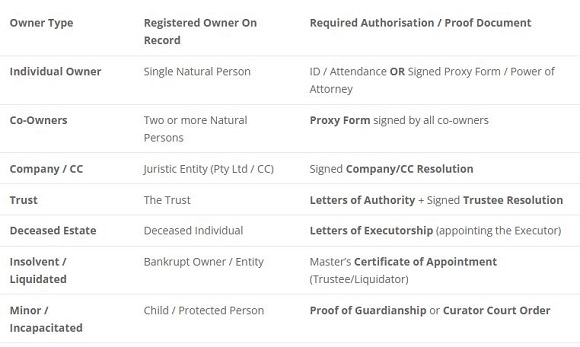
Quick Reference Summary for Managing Agents & Trustees
When checking in members or compiling the voting register for a general meeting, ensure your administrative checklist covers the following:
Practical Takeaway
Managing agents and chairpersons should distribute an Authorisation & Proxy Pack well in advance of any AGM or SGM. Requesting that co-owners lodge their proxies and other owners requiring authorised representation to lodge their relevant authorisation documentation at least 48 hours prior to the meeting will eliminate administrative bottlenecks and ensure that every resolution passed stands up to legal scrutiny.
Courtesy: Paddocks

Article reference: Paddocks Press: October 2026, Volume 21, Issue 9
This article is published under the Creative Commons Attribution license.
Please note: Paddocks Club is our membership-only platform with a wealth of resources accessible for a nominal fee. It’s also the quickest and most affordable way to get reliable advice on sectional title issues whenever you need it. Here, members can ask questions and have them answered by Jennifer Paddock, usually within 24 hours. For more info and to join, visit https://club.paddocks.co.za
